In Bangladesh the substation is usually decided before the transformer is: how high the plinth sits, where the water goes, and which way the cables enter. A unit that is electrically correct and installed 300 mm too low is a unit that will be switched off one monsoon, and the fix is a civil one that nobody budgeted for.
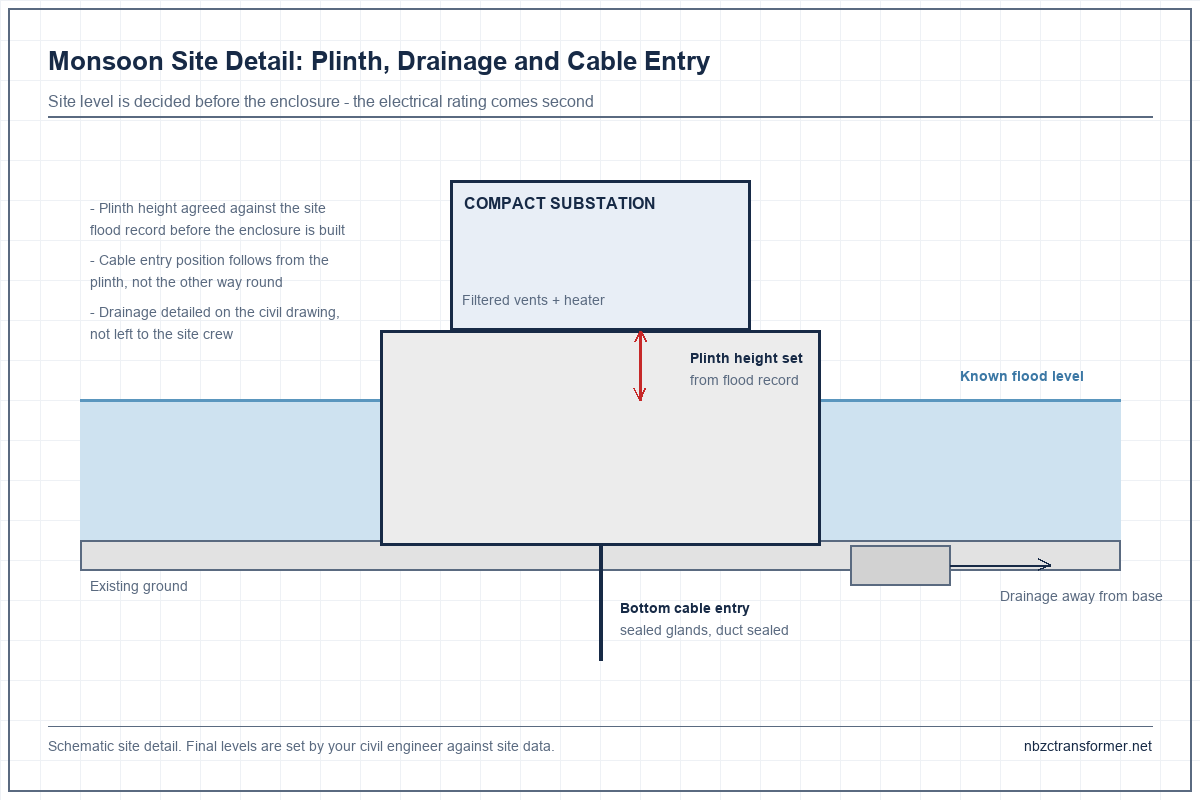
Set the Site Level First
Flood-prone districts need the plinth height agreed against the known flood level before the enclosure is built, not after. That single number then drives the cable entry position, the drainage around the base, and how the earthing is brought out. We issue the foundation loading, cable entry coordinates and earthing points on the arrangement drawing so your civil team can detail against real numbers.
- Plinth height — set from the site flood record, with margin for the drainage that will eventually silt up.
- Cable entry — bottom entry through sealed glands keeps water out of the enclosure; where the trench has to run at low level, duct sealing becomes part of the design.
- Drainage — around the base and away from it, detailed on the civil drawing rather than left to the site crew.
- Access — what happens when the road is under water and the transformer needs attention.
Then Deal With Humidity
Bangladesh has the same moisture problem as Vietnam, and the same answer for indoor rooms: cast resin windings up to 6000 kVA, because the encapsulation is indifferent to condensation. For outdoor enclosures the tools are different — filtered ventilation, anti-condensation heaters in the LV compartment, and a sealing detail that survives the daily wet-dry cycle. Ventilation is sized against a wet bulb that temperate designs never see, which is why copying a European arrangement drawing does not work here.
Network Context
The grid is 50 Hz at 230/400 V, with BPDB on the generation and transmission side, DESCO and DPDC in the Dhaka urban area, and the PBS network under REB across rural areas. Distribution voltages of 33 kV and 11 kV are standard, and specifications follow IEC 60076 through the utilities’ own data sheets. Factory substations are normally 11/0.4 kV with the owner responsible for the room and the utility for the metering point.
What We Supply
- Compact substations from 100 kVA to 8000 kVA for garment and textile factories.
- Dry type transformers up to 6000 kVA for indoor rooms in multi-storey factory buildings.
- Oil-immersed distribution transformers for utility feeders and rural electrification.
- Prefabricated substations where the site cannot host a conventional substation building.
Our Bangladesh page covers the grid bodies and the export process.
Testing and Delivery
Routine tests follow IEC 60076, with third-party witness testing where the utility or the lender requires it. Conformity is supported per project. Standard lead time is 30 days from drawing approval with a two-year warranty, quoted FOB, CFR or CIF.
Frequently Asked Questions
Who decides the plinth height?
It should come from your civil team against the site flood record. We supply the foundation loading and cable entry coordinates so the detail can be drawn against real numbers.
Dry type or oil-immersed for a garment factory?
Dry type up to 6000 kVA for indoor rooms; oil-immersed inside a compact substation for outdoor plots. Load density per floor usually settles it.
What is the lead time?
Standard lead time is 30 days from drawing approval, with a two-year warranty.
Talk to Our Engineering Team
Send the single-line diagram, the load list and the site conditions. We will come back with a proposed arrangement, the applicable standard set and a quotation on FOB, CFR or CIF terms. Email info@xsdfftransformer.com, call +8615867897761, or message WhatsApp +852 5416 2620.