MV switchgear is the part of a distribution system that switches, protects and isolates the medium-voltage side. It sits between the incoming supply and the transformer, and its job is to interrupt a fault without taking down anything that does not need to be taken down.
As an MV switchgear solution provider we are usually brought in at single line diagram stage, not at purchase order stage. That is deliberate: panel arrangement, protection settings and interlocking are far cheaper to change on paper than on a workshop floor. When you compare one switchgear manufacturer against another, the useful questions are about the interrupter, the arc containment and what the routine test report actually shows.
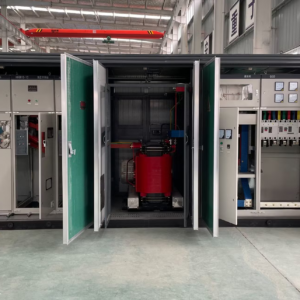
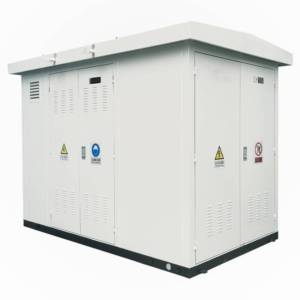
We supply it as a standalone assembly and, more often, as the MV compartment of a compact substation. The two are designed together, which avoids the usual problem of a switchgear panel and a transformer that were specified separately and do not quite fit.
Functions We Configure
- Incoming isolation – load break switch or withdrawable circuit breaker, depending on the fault level and your operator’s practice.
- Protection – overcurrent, earth fault and, where the network needs it, directional or differential protection, set from the study you provide.
- Metering – voltage and current measurement, energy metering and, on monitored units, a communication gateway.
- Surge protection – arresters selected for the system voltage and the exposure of the site.
- Interlocking – mechanical and electrical interlocks so the operating sequence cannot be got wrong.
Typical Parameters
| Parameter | What we normally supply |
|---|---|
| Rated voltage | 6 kV, 10 kV, 11 kV, 20 kV, 22 kV, 33 kV, 35 kV |
| Rated frequency | 50 Hz or 60 Hz |
| Insulation medium | Air, or SF6-free gas-insulated on ring main units |
| Construction | Metal-enclosed, compartmented |
| Mounting | Indoor cubicle or inside a compact substation |
| Standards | Built to the standard your project specifies |
Matching the Switchgear to the Network
The rating of a switchgear panel is not a catalogue decision. The fault level at the point of connection, the protection grading your operator requires and the switching device they are used to maintaining all shape the final arrangement. We ask for the short circuit study early, because a panel that is undersized on fault rating cannot be fixed later by adding accessories.
Where the project specifies IEC 62271-200 for the assembly, or a national equivalent, we confirm the applicable clauses with you before production starts. We do not claim a certification we have not been asked to obtain for your order.
MV Switchgear and RMU Units in Our Range
Frequently Asked Questions
What does MV switchgear do?
It switches, protects and isolates the medium-voltage side of a distribution system. It carries the normal load current, interrupts fault current, and provides a visible, lockable isolating gap so maintenance can be done safely.
What is the difference between a ring main unit and a switchgear panel?
A ring main unit is a compact sealed assembly used on ring and radial distribution networks, usually with load break switches and a breaker or fuse for the transformer feeder. A switchgear panel is the more general term and covers larger, extendable metal-enclosed assemblies.
Can you supply switchgear without the transformer?
Yes. We supply standalone MV assemblies, and we also supply them fitted inside a compact substation when the project wants one package.
How are the protection settings decided?
From the short circuit and protection grading study for your network. We build and wire to the scheme you specify; the settings are confirmed at commissioning against the study.
Do you use SF6?
Air-insulated assemblies and sealed gas-insulated ring main units are both available. Where your specification rules out SF6, we offer the SF6-free insulated option.
How MV Switchgear Is Specified for a Distribution Substation
Most switchgear enquiries arrive with the voltage already fixed by the upstream network — 11 kV, 22 kV or 33 kV — and the rest of the design follows from that number. What needs more thought is the short-time withstand current and the internal arc classification, because both are set by the fault level at your point of connection, not by the nominal voltage. A board that looks identical on a drawing can be a completely different product once those two ratings change.
Four ratings decide the design:
- Rated voltage and insulation level (Um 12, 24 or 36 kV) — sets the clearances, the busbar section and the insulator type.
- Short-time withstand current — taken from your short-circuit study; distribution boards are commonly specified in the 20–31.5 kA range for 1 s or 3 s.
- Internal arc classification (IEC 62271-200, AFLR) — decides whether pressure is ducted out of the room and how doors and covers are secured.
- Secondary circuit scope — protection relay functions, CT and VT ratios, metering, and the interlocks with the transformer and the LV board.
We issue the arrangement drawing before production starts: plan view, cable entry positions, earthing points and foundation loading. Your civil team can work from that while the board is still on the assembly floor, which is usually where the schedule is won or lost.
If the switchgear is going into an enclosure rather than a substation room, see compact substations. For protection schemes and interlocks, see switchgear control and protection.
Talk to Our Engineering Team
Send us your single-line diagram, load list and site conditions. We will come back with a proposed arrangement, the applicable standard set, and a quotation. Email info@xsdfftransformer.com or call +8615867897761.