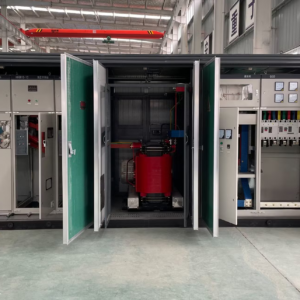
A compact substation brings the medium-voltage switchgear, the distribution transformer and the low-voltage distribution board into one factory-built enclosure. Instead of building a substation room on site, you receive a unit that has already been assembled, wired and tested, then set it on a prepared foundation and terminate the cables.
Most enquiries come from two directions: EPC companies who need the unit on site by a fixed date, and solar developers matching the package to an inverter and grid-connection specification that is not final yet. Either way the answer is the same — send the single line diagram and we will confirm what we can build to.
We build these units for utility distribution networks, industrial plants, renewable projects and commercial developments. The ratings below are the ones we ship most often; anything outside them is handled as a project-specific design.
What Goes Inside a Compact Substation
A standard unit is split into three compartments that are separated physically and electrically, so a fault or maintenance work in one section does not expose the others:
- MV section – incoming load break switch or circuit breaker, protection relay, surge arresters and metering, rated for the incoming medium voltage.
- Transformer section – oil-immersed or cast resin dry-type, sized to the load, with temperature monitoring and, on oil units, a bunded base to contain leakage.
- LV section – outgoing feeder breakers or fuse switches, a neutral bar, measurement and, where the project needs it, power factor correction.
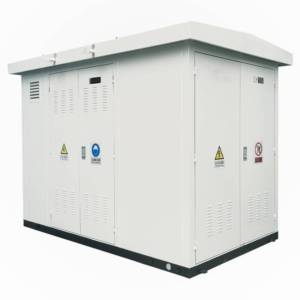
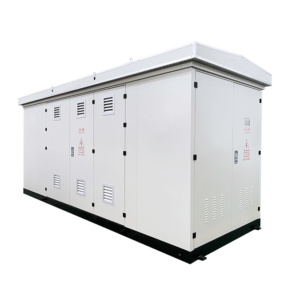
- Enclosure – galvanised and painted steel, stainless steel or a composite panel, with forced or natural ventilation and lockable doors.
Typical Ratings We Build
| Item | Range we normally supply | Note |
|---|---|---|
| Rated capacity | 100 kVA to 3,150 kVA | Higher ratings on request |
| Primary voltage | 6 kV, 10 kV, 11 kV, 20 kV, 22 kV, 33 kV | Per network voltage |
| Secondary voltage | 400 V / 415 V / 480 V | Other voltages on request |
| Frequency | 50 Hz or 60 Hz | Specified at order |
| Transformer type | Oil-immersed or cast resin dry-type | Project decision |
| Installation | Outdoor, free standing | Underground and semi-underground available |
Where Compact Substations Are Used
- Utility distribution – neighbourhood and rural feeders where a concrete substation building would cost more and take longer.
- Solar and storage – step-up units at the inverter station, and units with a spare bay for the battery converter.
- Industrial plants – a dedicated unit next to the load centre, which keeps cable runs short and voltage drop low.
- Construction and temporary supply – a unit that can be moved when the permanent substation is built.
How We Build Yours
We start from your single-line diagram rather than from a catalogue. The MV arrangement, the protection scheme and the enclosure material are decided against your network operator’s rules and the site conditions you give us – ambient temperature, altitude, coastal exposure, seismic requirement, access for maintenance.
Before production starts we issue arrangement drawings, a wiring diagram and a termination schedule for your approval. Routine tests are carried out on the finished unit, and the test reports travel with the equipment. Where your project specifies a standard – IEC 62271-202 for prefabricated substations, IEC 62271-200 for the MV switchgear, IEC 61439 for the LV assembly – we confirm the applicable clause set with you before we build, rather than assuming it.
Compact Substations in Our Range
Frequently Asked Questions
What is the difference between a compact substation and a prefabricated substation?
In everyday use the two terms overlap. A compact substation usually refers to the small kiosk-style unit for distribution networks, while prefabricated substation tends to be used for the larger walk-in type. Both are factory-assembled and tested before shipment.
Can the transformer be dry-type instead of oil-immersed?
Yes. Cast resin dry-type units are specified where fire risk, indoor installation or environmental rules rule out oil. We build both and will tell you what the choice does to the enclosure size and the ventilation.
How is the unit delivered?
Smaller units ship complete on a truck and are craned onto the foundation. Larger walk-in units may be split into transportable sections and jointed on site. We confirm the transport envelope with you before we finalise the layout.
Do you provide the foundation design?
We provide the foundation loading, the cable entry positions and the earthing points. The civil design itself is done by your local engineer, who knows the soil conditions.
What information do you need for a quotation?
The single-line diagram, the load list, the primary and secondary voltages, the short circuit level at the point of connection, the site conditions, and the standard your project specifies.
MV Power Modules: When a Compact Substation Is Split Into Sections
A compact substation normally arrives as a single enclosure: MV switchgear, transformer and LV board already wired and tested inside one housing. That works up to the point where the rating outgrows what one enclosure can carry, or the access road will not take the width. The same functions are then split into an MV module, a transformer module and an LV module, built and tested separately and joined on site with busbar links or cables. In enquiry language that arrangement is often called an MV power module or a modular substation.
We suggest the split when at least one of these applies:
- The transformer rating sits near or above the upper end of the single-enclosure range, so the unit cannot be lifted or transported in one piece.
- Site access limits width or height — a narrow gate, a bridge, an underground car park ramp.
- The project is phased and capacity will be added later, so a second transformer module is planned from the start.
- The owner wants the transformer replaceable without touching the switchgear.
Each module leaves the factory assembled and tested, so the site work is limited to joining sections and repeating the overall tests. See also prefabricated substations for walk-in and underground versions.
What Decides the Price of a Compact Substation
There is no useful list price for this product, because two units with the same kVA rating can differ by a wide margin. The variables that move the number are:
- Rating and insulation medium — the transformer size and whether it is cast resin, VPI or oil-immersed.
- Switchgear arrangement — number of panels, the short-time withstand current, and whether protection is relay-based or fuse-based.
- Enclosure and finish — degree of protection, anti-corrosion class, and whether a walk-in corridor or a landscape housing is required.
- Cooling and ventilation — natural ventilation, forced ventilation with filters, or air conditioning for hot or dusty sites.
- Metering and communications — revenue metering accuracy, remote monitoring, and the protocol expected by the utility.
- Transport and site conditions — split delivery, crane access, altitude, and seismic or wind requirements.
Send the single-line diagram and the load list and we will return a priced arrangement with the applicable standard set.
Talk to Our Engineering Team
Send us your single-line diagram, load list and site conditions. We will come back with a proposed arrangement, the applicable standard set, and a quotation. Email info@xsdfftransformer.com or call +8615867897761.