A transformer built for 50 Hz is not a transformer you can ship to a 60 Hz network and forget about. The voltage looks the same on the nameplate, the kVA rating reads the same, and the difference only shows up later — as an impedance figure that does not match the fault study, a temperature rise the room was not sized for, or a protection setting that nobody can reconcile. In the Philippines, where the grid runs at 60 Hz and most imported equipment arrives from 50 Hz markets, this is the single most common specification error we see.
What the Design Frequency Actually Changes
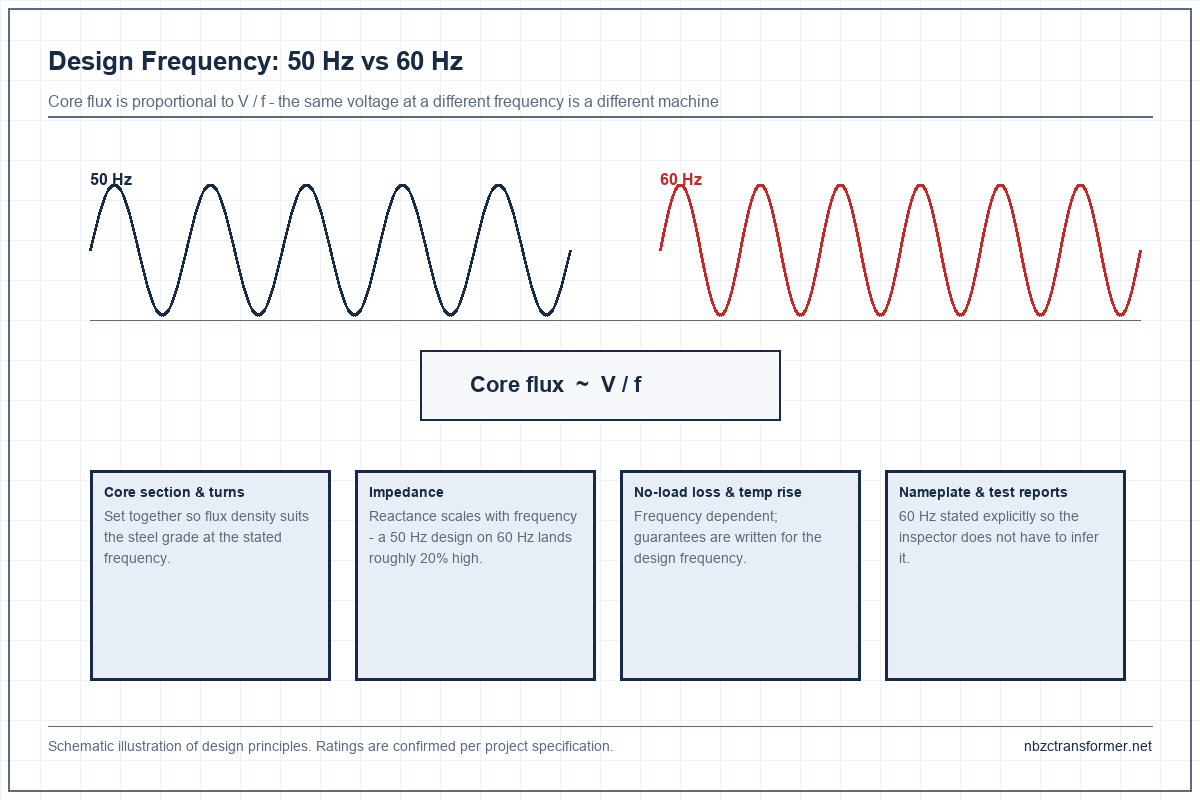
Flux in the core is proportional to voltage divided by frequency. Drop the frequency and the flux rises; the core moves toward saturation, magnetising current climbs, and the iron runs hot. That is why a 60 Hz transformer connected to a 50 Hz supply is a real problem rather than a paperwork one. The other direction is less dramatic but still wrong: a 50 Hz design on a 60 Hz supply under-uses the core, while reactance scales with frequency, so the short-circuit impedance lands roughly 20 per cent above what the fault study assumed and voltage regulation shifts with it.
In practice the design frequency is decided at drawing stage and then shows up in four places on the document set:
- Core section and turns — set together so the flux density sits where the grade of steel performs best at the stated frequency.
- Impedance — quoted at the design frequency, on the same base as your fault study.
- Losses and temperature rise — no-load loss is frequency dependent, so the guarantee is written for 60 Hz, not borrowed from a 50 Hz type test.
- Nameplate and test reports — 60 Hz stated explicitly, so the inspector does not have to guess.
Network Context
Transmission runs under NGCP, with MERALCO as the largest distribution utility and a set of provincial utilities and cooperatives covering the rest of the archipelago. Low-voltage supply is 230/400 V at 60 Hz. Equipment is generally specified to the Philippine Electrical Code with IEC-based data sheets, and projects backed by American partners sometimes ask for ANSI-format figures. We can present the test data in either form, but the transformer itself is built to one frequency and one set of ratings — that is not negotiable.
What We Supply for 60 Hz Projects
- Compact substations from 100 kVA to 8000 kVA, transformer plus MV switchgear and LV board in one tested enclosure.
- Dry type transformers up to 6000 kVA for indoor rooms in commercial and mixed-use buildings.
- Oil-immersed distribution transformers from 250 kVA to 16 MVA for utility and estate networks.
- MV switchgear rated 6 kV to 35 kV.
More detail on the market itself is on our Philippines page, including how we handle PS and ICC conformity per project.
Typhoon, Salt and Heat
Two site conditions drive the enclosure specification more than the electrical rating does. Coastal exposure brings salt haze, which attacks standard paint systems and fasteners long before the windings are anywhere near the end of their life, so outdoor units get an increased anti-corrosion class and stainless hardware. Typhoon exposure sets the anchoring, the wind loading and the door and roof sealing — a compact substation that is weathertight in Europe will leak in a Philippine squall if the gasket detail was not designed for driving rain. Indoors, the review is simpler: ventilation sized against high ambient, and humidity control in the room.
Testing and Documentation
Routine tests follow IEC 60076 and are performed at the design frequency. Where the project requires it, we arrange factory witness testing, and we support conformity work per project with the test reports and inspection coordination the scheme asks for. Standard lead time is 30 days from drawing approval with a two-year warranty; quotations are issued FOB, CFR or CIF.
Frequently Asked Questions
Can a 50 Hz transformer be used on a 60 Hz supply?
It will usually run, but not to its stated figures: reactance scales with frequency, so impedance rises about 20 per cent and voltage regulation moves with it. The correct approach is to build for 60 Hz from the drawing stage.
Do you supply 60 Hz transformers as standard?
Yes. 60 Hz compact substations and distribution transformers are standard product lines for us, and the design frequency is stated on the nameplate and in the test reports.
What is the lead time for a Philippine project?
Standard lead time is 30 days from drawing approval, with a two-year warranty on the equipment.
Talk to Our Engineering Team
Send the single-line diagram, the load list and the site conditions. We will come back with a proposed arrangement, the applicable standard set and a quotation on FOB, CFR or CIF terms. Email info@xsdfftransformer.com, call +8615867897761, or message WhatsApp +852 5416 2620.