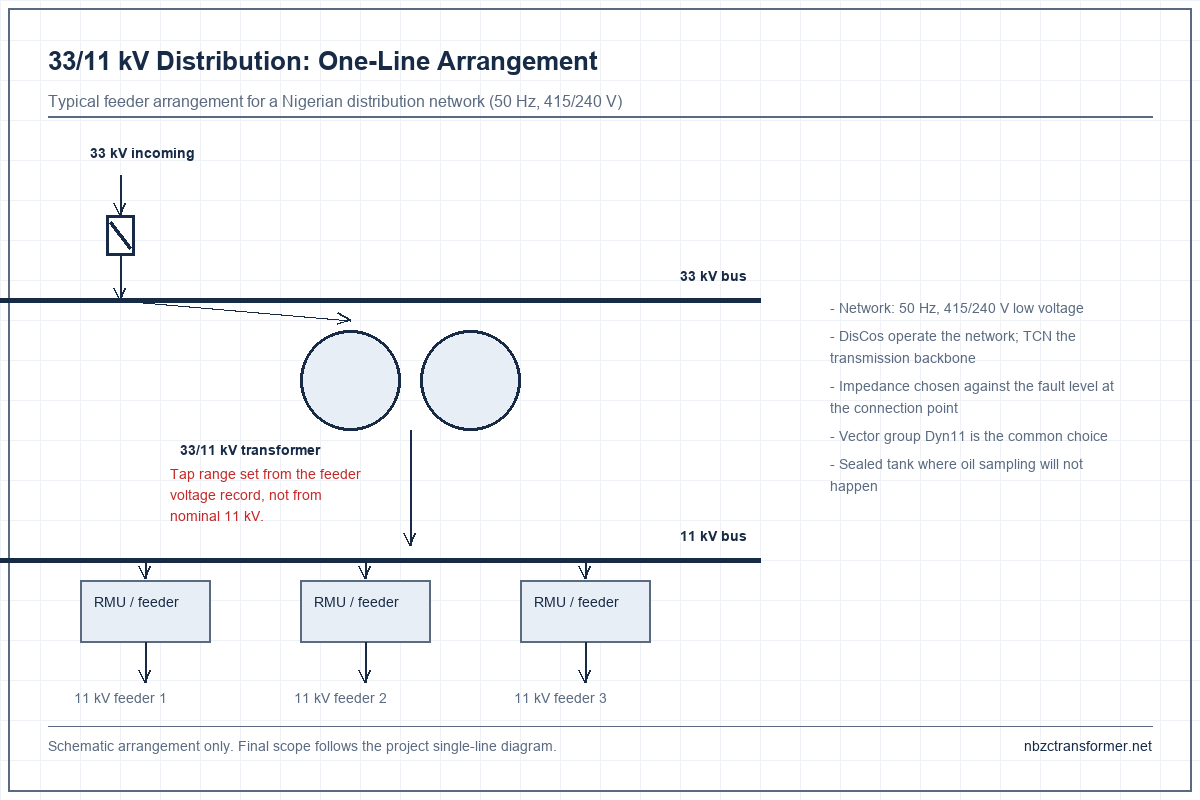
The first question to answer on a Nigerian feeder is not the kVA rating — it is how far the voltage actually sits from nominal. A transformer specified for a clean 11 kV may spend its working life somewhere between 9.5 kV and 11.5 kV, and every hour it spends away from the tap it was set to is an hour of secondary voltage the plant downstream has to live with. Get the tap range wrong and no amount of rating headroom will fix the complaint.
Start From the Feeder Profile, Not the Nameplate
Distribution runs at 33 kV and 11 kV under the DisCos, with TCN operating the transmission backbone, at 50 Hz and 415/240 V on the low-voltage side. IEC 60076 covers the ratings and the tests. What it does not cover is the behaviour of your particular feeder, which is why we ask for a voltage record or at least a stated range before quoting rather than defaulting to a standard tap arrangement.
- Tap range — sized to the observed spread, not to the nominal voltage. Off-circuit taps are usual for distribution units; on-load tap changers come into the discussion where the load swings widely through the day.
- Impedance — chosen against the fault level at the point of connection, and checked against the voltage drop the feeder can tolerate.
- Cooling — ONAN is normally enough for distribution ratings, but the ambient design point matters: 40 °C is a working afternoon in much of the country, not a peak.
- Vector group and earthing — Dyn11 is the common choice; the neutral arrangement has to match the network practice your DisCo applies.
What We Supply for 33/11 kV Networks
- Oil-immersed distribution transformers from 250 kVA to 16 MVA at 11 kV and 33 kV.
- Ring main units for 11 kV loop networks feeding residential and commercial districts.
- Compact substations from 100 kVA to 8000 kVA for estates, campuses and industrial plots.
- MV switchgear and LV boards to the single-line diagram.
Our Nigeria page covers the grid context and how we support SONCAP documentation per shipment.
Dust, Heat and the Maintenance Reality
Harmattan dust is fine, dry and pervasive, and it finds its way into outdoor enclosures and cooling paths. Filtration on ventilation openings and a sensible degree of protection on outdoor compartments cost very little at design stage and save a great deal of cleaning later. The second question is maintenance practice: if the unit is unlikely to get regular oil sampling, a sealed tank design is the honest answer, and it is better to say so in the specification than to ship a conservator unit that nobody will check.
Testing and Export Documentation
Routine tests follow IEC 60076, with type-test evidence supplied where the consultant asks. For SONCAP we support the process per shipment — test reports, audit support where the scheme requires it, and coordination with the inspection agent nominated for the consignment. Standard lead time is 30 days from drawing approval with a two-year warranty, quoted FOB, CFR or CIF.
Frequently Asked Questions
What tap range should I specify for a Nigerian feeder?
Size it to the voltage record for the feeder rather than to nominal. If you do not have a record, tell us the observed spread and we will set the range accordingly.
Sealed tank or conservator?
If the site will not get regular oil sampling, specify a sealed design. It removes the maintenance step instead of assuming it will happen.
What is the lead time?
Standard lead time is 30 days from drawing approval, with a two-year warranty.
Talk to Our Engineering Team
Send the single-line diagram, the load list and the site conditions. We will come back with a proposed arrangement, the applicable standard set and a quotation on FOB, CFR or CIF terms. Email info@xsdfftransformer.com, call +8615867897761, or message WhatsApp +852 5416 2620.