Efficiency rules for transformers have tightened twice in recent years on the two largest markets, and both changes affect what a buyer should put in a specification. This article summarises the current positions and, more usefully, explains how to compare two transformers on loss once the minimum standard is satisfied.
What the standards actually regulate
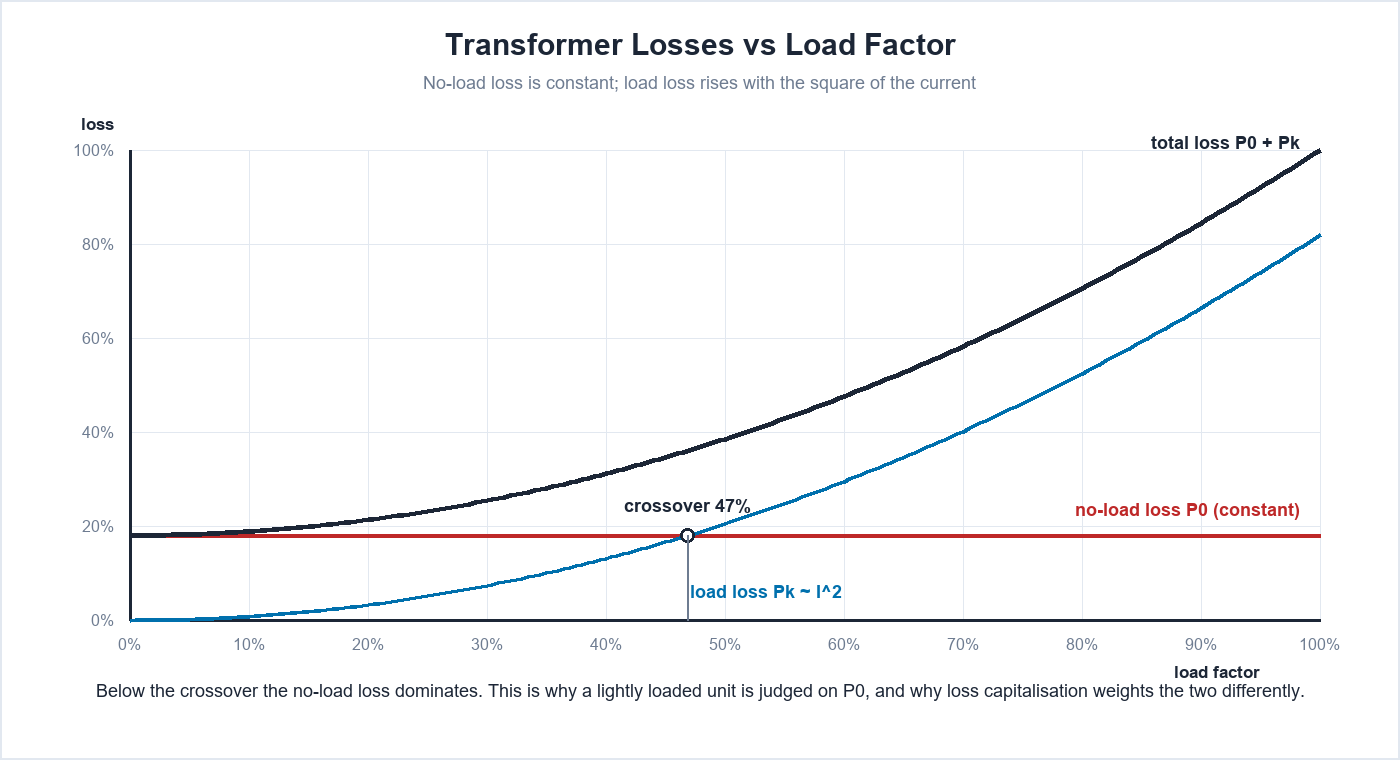
Two loss figures describe a transformer’s efficiency completely. The no-load loss is drawn continuously whenever the unit is energised, loaded or not, and comes from the core. The load loss rises with the square of the current and comes from the windings. Every efficiency requirement in this article is expressed as a limit on one or both of those numbers, or on an index derived from them.
This is also why a single efficiency percentage can mislead. Efficiency depends on the load factor at which it is quoted, and two units with the same peak efficiency can behave very differently at the load factor your site actually runs at.
EU Ecodesign: Tier 2 has applied since July 2021
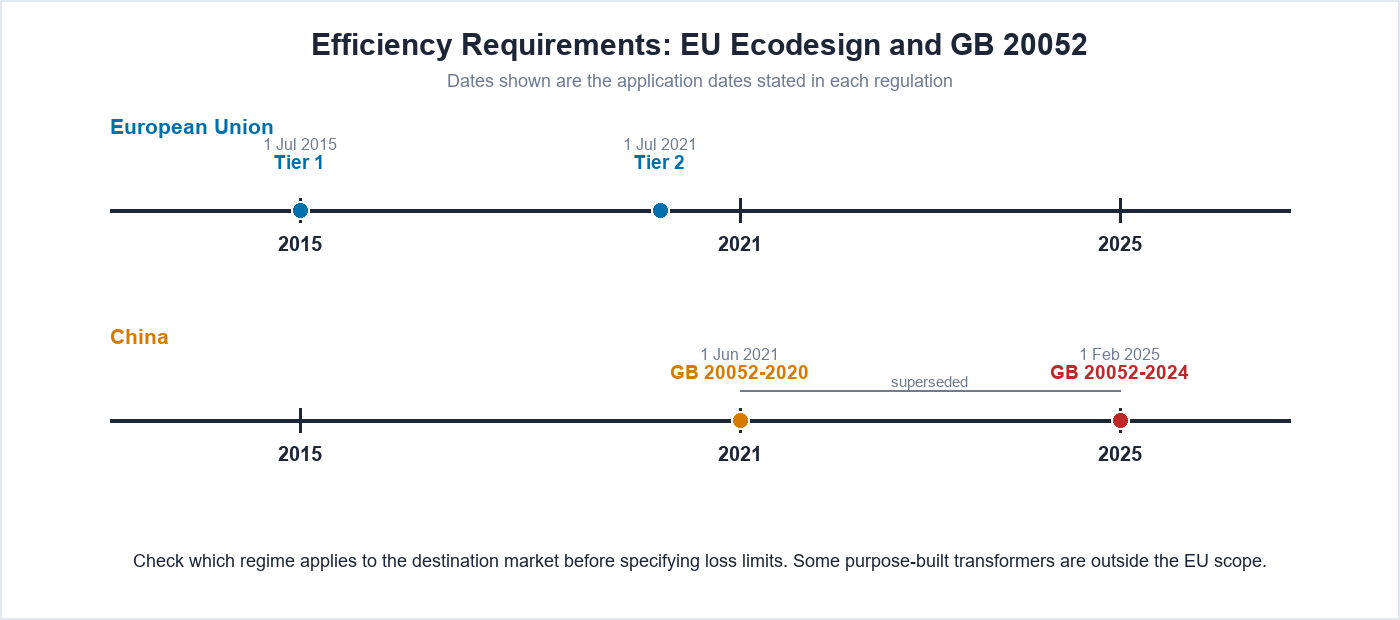
In the European Union, Regulation (EU) 548/2014 set minimum energy performance for power transformers, with Tier 1 applying from 1 July 2015. Commission Regulation (EU) 2019/1783 tightened it, and the Tier 2 requirements have applied since 1 July 2021.
For dry-type transformers with a rated power above the medium-power tables, the requirement is expressed as a minimum Peak Efficiency Index rather than a loss table. For medium power transformers, Tier 2 reduces the maximum no-load loss by 10% relative to Tier 1 while the load loss limits are unchanged.
One point is easy to miss: the regulation covers transformers placed on the market for general power transmission and distribution. Transformers built for specific applications, including converter-duty and furnace duty, fall outside its scope. A specification should state which category the unit belongs to rather than assume.
GB 20052-2024: the current Chinese requirement
China’s mandatory standard GB 20052-2024 was published on 29 April 2024 and applies from 1 February 2025, replacing GB 20052-2020 in full. It defines minimum allowable loss values and three energy efficiency grades for power transformers.
For equipment supplied into the Chinese market, the applicable edition is therefore a matter of the date the unit is placed on the market, and a specification written before February 2025 may reference limits that no longer apply.
How to compare two transformers on loss
Start from the two numbers on the test report, then apply them to your load.
- The no-load loss is paid for 24 hours a day, every day of the year, for the life of the unit.
- The load loss is proportional to the square of the load, so a unit running at half load produces a quarter of its rated load loss.
- Below the load factor where the two are equal, the no-load loss dominates the running cost. Above it, the load loss does.
A transformer that spends its life lightly loaded should be judged mainly on its no-load loss, which is why the standards tighten P0 specifically. A unit on a continuously full process load is judged mainly on load loss.
Loss capitalisation: how buyers actually compare
Utilities and large industrial buyers rarely compare transformers on purchase price alone. The usual method is loss capitalisation: the buyer assigns a monetary value per watt of no-load loss and per watt of load loss, and the evaluated cost becomes the purchase price plus A times P0 plus B times Pk.
The capitalisation factors come from the buyer’s electricity tariff, expected load factor, and discount rate, and they shift the comparison substantially. A unit with slightly higher purchase price and lower losses is frequently the cheaper option over a 25-year life, which is the argument behind the tightening standards in the first place.
If your organisation does not publish factors, it is still worth stating the load profile and the expected energy cost so the comparison can be made on your behalf.
What to send us
- The market the transformer will be installed in, so the applicable regime is clear.
- Rated power, voltages, and the expected load profile.
- Any loss capitalisation factors your organisation applies.
- Whether the duty is continuous, cyclic, or strongly peak-driven.
- The applicable standard for the rest of the design: IEC 60076, GB 1094, or a customer specification.
See the dry type transformer range, the rectifier transformer range for converter duty, or contact us with the requirement.
Related Products
Related Applications
Request a Custom Quote
Need a custom transformer for your application? Send us your technical requirements and our engineering team will provide a custom solution within 24-48 hours.
Related equipment
If you are specifying this as part of a larger distribution scheme, the surrounding scope is covered on the industrial power distribution, solar power plant substations, wind farm substations and transformer substation packages pages.
Frequently Asked Questions
What is the first thing to establish with transformer efficiency requirements?
Start from the load and the environment, then let the equipment follow. Working from a catalogue rating backwards is how projects end up with either a marginal unit or one that costs money sitting under-loaded.
What changes when the transformer is part of a renewable or storage project?
Power flows in both directions in storage applications, and inverter-fed supplies carry harmonics. Protection coordination and winding configuration are decided with that in mind rather than from a standard distribution template.
Does the intermittent duty affect the transformer specification?
It can. A unit that runs near full load for a few hours and sits at low load otherwise has a different loss profile from one at steady load. Ambient temperature and enclosure conditions often matter more here than the average loading.
Which standard applies, and is it certified?
The applicable standard and clause set are agreed against your project specification before production starts. Where a project names IEC 60076 for the transformer, we work to those clauses and the routine test report ships with the unit.
What do you need from us to quote?
The single-line diagram or a description of the application, the voltages, the load with its duty, the site conditions, and any standard the project specifies. Send what you have – if something is missing, it can be worked out together rather than delaying the enquiry.