Most industrial electrical problems that surface years after commissioning trace back to a single document: the medium voltage distribution single line diagram. Voltage level, transformer rating, substation location and redundancy are all fixed on that drawing — and all of them are expensive to change later.
This guide works through the decisions in the order they have to be made, from load assessment to equipment specification, for a new plant or a significant expansion.
Start with the load, not with the voltage
The first output of a distribution study is not a voltage level. It is a number: the calculated plant load.
- List every load. Motors, furnaces, rectifiers, compressors, HVAC, lighting and any planned expansion.
- Apply a diversity factor. Installed capacity is always higher than simultaneous demand. Sizing on installed capacity alone produces an oversized and inefficient system.
- Separate the loads that matter. Large motor drives, DC processes with high harmonic content, and loads that must stay energised during a supply disturbance each drive a different requirement.
That result — in kVA or MVA — together with the physical layout of the site and the supply the utility can offer, drives every decision that follows.
Choosing the incoming voltage level
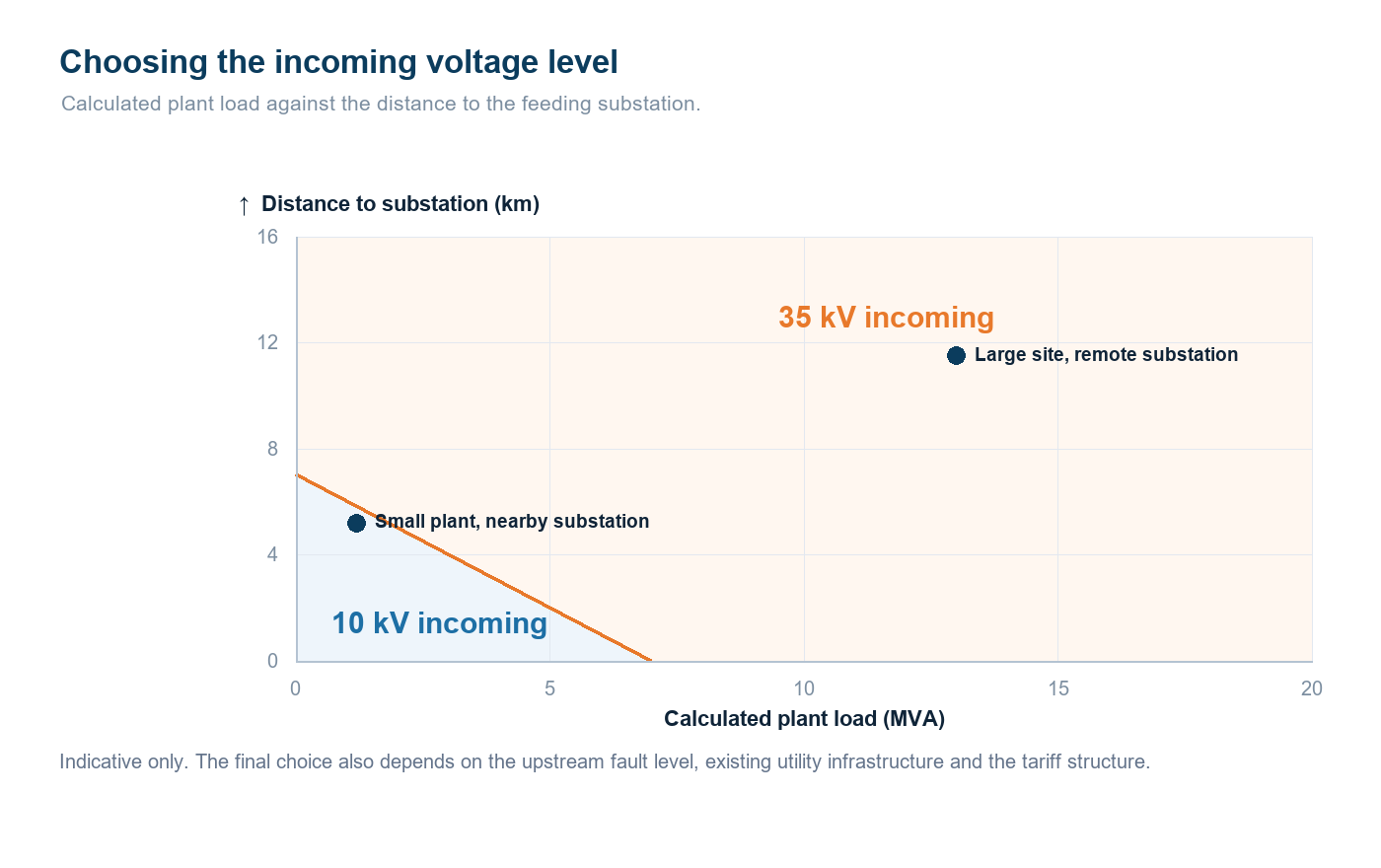
Industrial sites usually have a choice between a 10 kV and a 35 kV incoming supply, and the decision depends mainly on two variables: the calculated load and the distance to the point where the utility can supply you.
- 10 kV is economical for smaller plants fed from a nearby substation
- 35 kV takes over as calculated load grows or as the supply distance increases, because it carries more power at lower current and therefore with lower losses
The available fault level at the connection point matters too. A 35 kV supply gives a stronger system and lower voltage distortion, which can simplify harmonic compliance for plants with rectifier or furnace loads. If your site includes significant DC load, it is worth reading how pulse number affects harmonic current before the voltage level is fixed.
One substation or several?
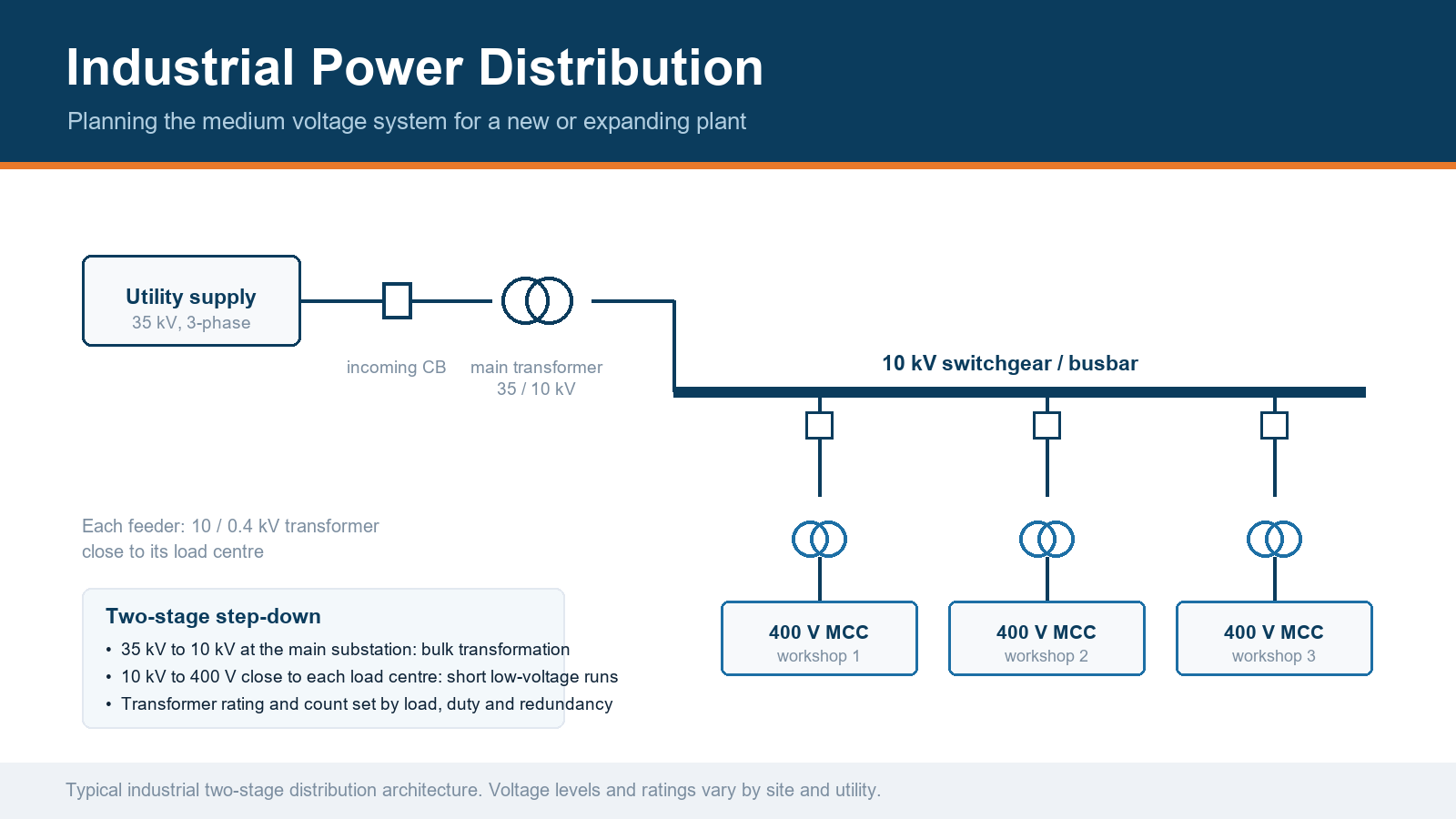
A single large substation is cheaper to build and easier to maintain. A distributed arrangement costs more in switchgear but saves on the low voltage side.
The trade-off is cable cost and cable loss. Low voltage cables carry high currents, so they are thick, expensive and lossy. Once a load centre sits more than a few hundred metres from the main substation, it is usually cheaper to run a medium voltage feeder to a small transformer near the load than to run a large low voltage cable back to the main board.
- Feed each major process area from its own medium voltage feeder and transformer
- Keep low voltage runs short — as a general guide, under 150–200 m
- Group small scattered loads onto a shared transformer rather than giving each one a dedicated supply
Sizing the distribution transformer
Transformer rating is set by more than connected load. Four factors decide the final number:
- Loading. Transformers run most efficiently and age slowest at moderate loading. Design for a normal operating load around 50–70% of rating so daily peaks stay inside the unit’s capability.
- Harmonic and non-linear load. Rectifiers, drives and furnaces generate harmonic currents that increase winding losses. Where non-linear content is significant, either derate the transformer or specify it with those additional losses included.
- Ambient conditions. Rated capacity assumes a reference ambient temperature. A hot, poorly ventilated room or a high-altitude site reduces the usable rating.
- Redundancy. If process continuity matters, two transformers at 50–60% each may serve the load better than one at 100%, because a single failure leaves the plant running.
Impedance is easy to overlook and expensive to get wrong. Two transformers operating in parallel must have matched impedance and ratio, or one will carry most of the load. Where a high fault level is the problem, a higher impedance transformer is one way to limit it — at the cost of slightly worse voltage regulation.
Dry type or oil immersed at each location?
In a distributed layout this is a decision per transformer, not one decision for the whole plant:
- Dry type (cast resin) suits indoor plant rooms, basements, cable rooms and any location where an oil spill or a fire load is unacceptable. No oil, no bunding and minimal maintenance — a cast resin unit runs in a normally ventilated room.
- Oil immersed suits outdoor installation, higher ratings, and locations where lower first cost matters more than indoor fire performance.
A mixed installation is entirely normal: oil immersed at the outdoor main substation, cast resin at the indoor load centres.
Our dry type and cast resin transformers are built for industrial duty, with thermal classes and cooling options matched to the actual load profile. You can also read a direct dry type versus oil immersed comparison before deciding.
What belongs in the specification
A distribution transformer specification for an industrial plant should include:
- Rated power, primary and secondary voltage, and vector group
- Tap range and tap changer type
- Impedance, and the impedance tolerance permitted for parallel operation
- Harmonic content to be carried, and any derating applied for it
- Insulation level and the applicable standard — IEC 60076 or GB 1094
- Cooling class, plus the ambient and altitude conditions it is rated for
- Enclosure or IP rating, and cable entry requirements
- Routine tests and any type or special tests required
- Documentation: test reports, drawings and nameplate data
Send the specification and we will confirm the rating, impedance and cooling before quoting, and flag anything in the design that will create a problem later.
Next step
If you are planning a new plant distribution system or expanding an existing one, our engineering team can review your single line diagram and confirm the transformer rating, impedance and type for each substation.
Browse our industrial transformer range, see some of the distribution projects we have delivered, or contact us with your load list to start the discussion.