A compact substation has no catalogue price, and the reason is arithmetic rather than sales policy. The transformer, the MV switchgear, the LV panel, the busbar between them and the length of the enclosure are all sized from one number, and that number comes out of the load list. Ask for a price before the list exists and what you receive belongs to somebody else’s plant.
So here is the calculation, carried through once on a small factory load list. Four steps, every one of them arithmetic you can repeat on your own figures, and at the end the rating tells you what the enclosure has to contain.
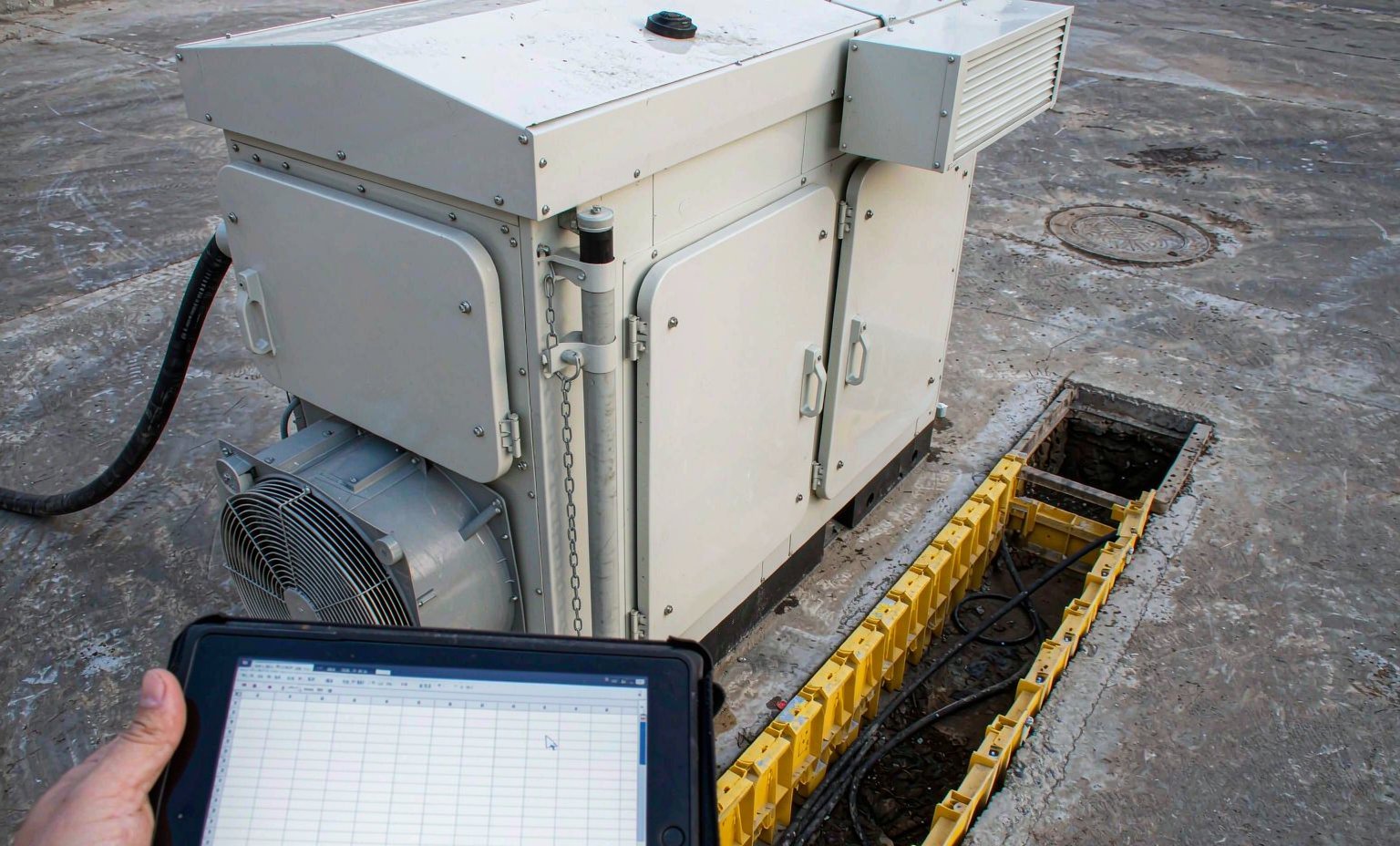
Step 1: build the load list, then apply diversity circuit by circuit
Installed load first: four 90 kW pumps with one on standby, two 45 kW chillers, 40 kW of lighting and small power, and one 250 kW process heater. Installed total is 360 + 90 + 40 + 250 = 740 kW. It is not the number you size to.
Apply diversity per circuit rather than one blanket factor across the board. Three of four pumps run at once, so 0.75 × 360 = 270 kW. Both chillers run at 0.9 × 90 = 81 kW. Lighting and small power is taken at 0.8 × 40 = 32 kW. The heater is either on or off, so it stays at 250 kW. Maximum demand is 270 + 81 + 32 + 250 = 633 kW. A single 0.85 factor over the whole 740 kW would have given 629 kW — close by luck here, and wrong by a wide margin the moment one circuit is a standby set or a batch heater.
Step 2: convert kW to kVA, and treat power factor as a decision
Apparent power is S = P / cos φ. At the uncorrected 0.85 you would probably measure on a mixed board like this, 633 / 0.85 = 744.7 kVA. Fit a capacitor bank and hold the bus at 0.95, and the same 633 kW needs 633 / 0.95 = 666.3 kVA. The difference is about 78 kVA, which on a standard rating ladder is often the difference between two sizes of transformer.
So do not send the power factor you happen to have. Send the one you intend to hold, because it is a design input: the bank costs money, the transformer and the cable get smaller, and the current you pay to lose as heat in the busbar falls with it. If your tariff penalises a low power factor, the target is usually set for you.
Step 3: margin, the standard rating, and the site correction
The plant intends to add a process line, so allow 20 per cent: 666 × 1.2 = 799 kVA. Ratings are not built to order in arbitrary sizes — IEC 60076 works on a preferred ladder, and the rung above 799 is 800 kVA. In this case the margin was nearly free, which is the point of doing the arithmetic before choosing rather than after.
Then correct for the site. Ratings quoted under IEC 60076 assume a 40 °C ambient and installation below 1,000 m. A yard that sits at 45 °C in summer, or a site at 2,000 m, changes the rating: either step to the next standard size or specify a design that accounts for it. The correction has to be applied by whoever signs the rating, so put the ambient range and the altitude on the enquiry rather than discovering the derating at commissioning.
Step 4: the rating decides what fits inside the enclosure
Take the LV side first. Line current is I = S / (√3 × V), so 800,000 / (1.732 × 400) = 1,155 A. That single figure fixes the main breaker frame, the busbar section and how many outgoing ways physically fit on the panel. On the 11 kV side the same transformer draws 800,000 / (1.732 × 11,000) = 42 A, which is why MV protection is dimensioned by the fault level it must interrupt rather than by the load it carries.
The fault level comes from the impedance you specify. Assume 6 per cent: three-phase fault current is S / (√3 × V × Z), giving 800,000 / (1.732 × 400 × 0.06) = 19,231 A, about 19.2 kA on the LV bus. The panel and the busbar bracing have to be rated above that, and the next common frame size is 25 kA. Every one of those numbers — breaker, busbar, bracing, enclosure length — came from 633 kW. Selecting the MV switchgear follows the same chain on the incoming side.
The transformer itself is the last choice, not the first. Cast resin dry-type suits indoor and fire-sensitive installations and is offered up to 6,000 kVA; oil-immersed runs from 250 kVA to 16 MVA and suits an outdoor yard. Both are built into compact substations across a 100–8,000 kVA range on 6–35 kV systems, and the dry-type range shows where the resin-cast option usually lands.
Why the price has to follow the rating
Put the chain in order and the answer to an early price question becomes obvious: load list, diversity, power factor, margin, site correction, standard rating, then switchgear and panel. A quotation produced before step one is a range dressed as a number, and ranges have a habit of moving once the real rating arrives.
What we need is short: the load list with the diversity you assumed, the target power factor, any planned expansion, the ambient range and altitude, the MV voltage and available fault level, and whether the unit stands indoors or out. Delivery runs 30 days from approved drawings and the warranty is 2 years. Certification and type-test requirements are supported per project rather than assumed from a fixed package. What goes inside the enclosure is covered separately, and the compact substation and transformer substation ranges show the usual arrangements.
Frequently Asked Questions
Should I size for today’s load or for the planned expansion?
Size for today plus a margin you can justify on paper. In the example, 20 per cent took 666 kVA to 799 kVA and the next standard rating was 800 kVA, so the margin cost almost nothing. Jumping to 1,250 kVA for a line that may not be built for five years is a different decision, and a second unit later usually costs less than replacing the first.
Dry-type or oil-immersed inside the enclosure?
It follows from where the unit stands and what your insurer requires. Cast resin dry-type suits indoor and fire-sensitive installations and is available to 6,000 kVA. Oil-immersed suits an outdoor yard and runs from 250 kVA to 16 MVA. Tell us the location and the local rule and the choice is usually already made.
Can you quote a compact substation from a one-line description?
Not usefully. Without the load list the rating is unknown, and the rating sets the transformer, the switchgear, the busbar and the enclosure length. Send the load list and the site conditions and the quotation will carry a general arrangement drawing instead of a range.
Send Us the Load List
A spreadsheet is fine, even a photo of a handwritten one. Email info@xsdfftransformer.com, call +8615867897761, or message WhatsApp +852 5416 2620. You can also send it through our enquiry page.